Week in Review
Oil, heating pads, rugs, razors, and drinks – no, this isn’t about preparing for a romantic interlude, but rather the products featured in the I-think-you’re-lying-to-me category during the week of…
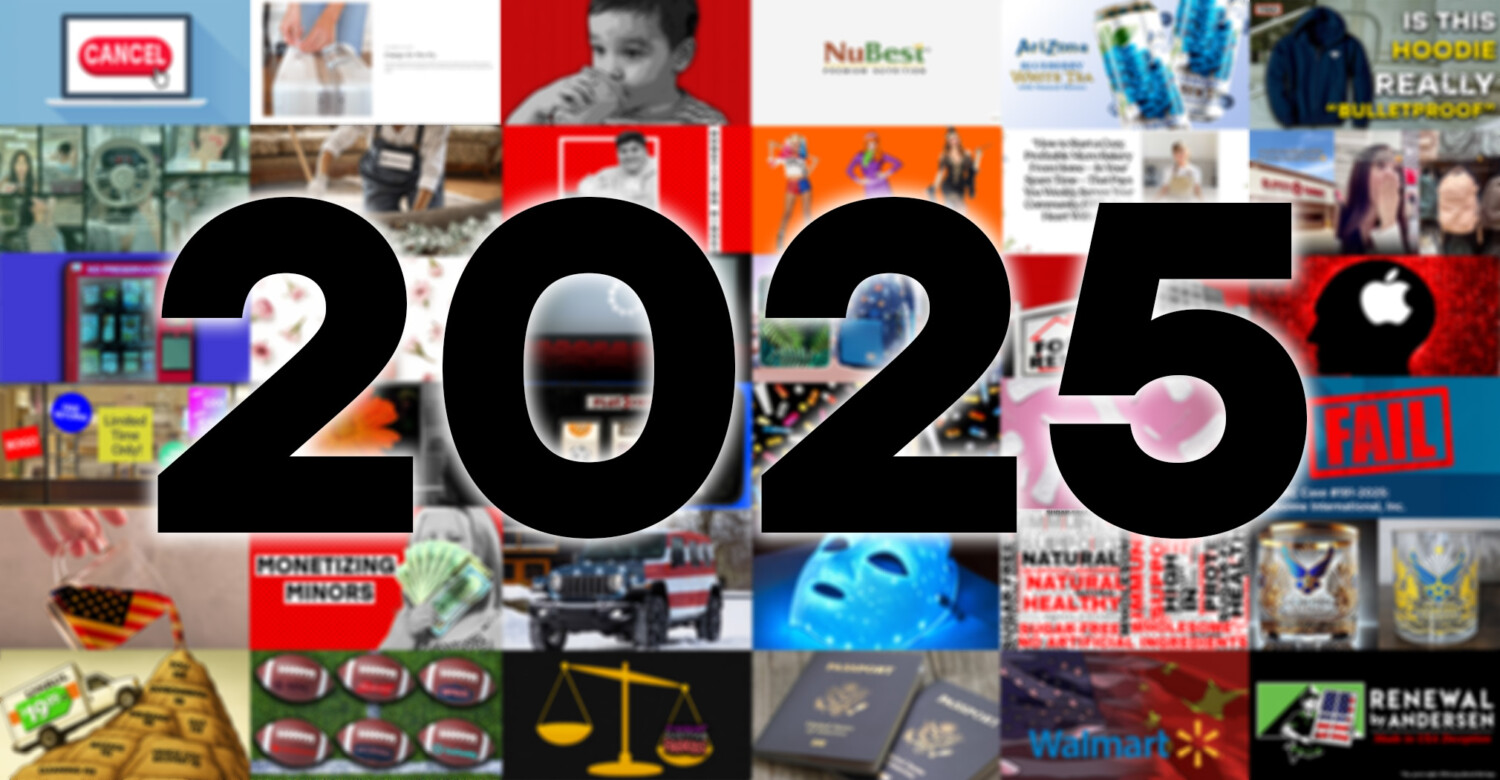
TINA.org continued to make a meaningful impact in 2025. Alongside our ongoing efforts to hold deceptive advertisers accountable and promote honesty in the marketplace, we dedicated significant time and resources this year to advancing several in-depth, long-term investigations across a range of companies and industries. Many of these projects are still underway, and we look forward to sharing the results of that work with you in the months ahead. What follows is a summary of TINA.org’s accomplishments in 2025 and the progress we made toward a more transparent and truthful advertising landscape. (Click each title to learn more.)
TINA.org pursued an ambitious slate of legal and regulatory actions in 2025, reinforcing its role as a leader in the fight against deceptive marketing. Over the course of the year, these efforts included filing three complaints to the FTC, submitting complaints to more than 20 state regulators, authoring three amicus curiae briefs, issuing a warning letter addressing deceptive practices by three major brands, and providing expert testimony at an FTC informal hearing on a proposed rule.
Through its regulatory complaints, TINA.org called out deceptive marketing by several well-known advertisers. Targets included U-Haul, one of the nation’s largest moving truck rental companies for misleading pricing and hidden fees; Renewal by Andersen, a subsidiary of a multibillion-dollar window manufacturer for deceptive Made in USA claims; and Homeaglow, a home-cleaning services platform used by nearly 100,000 U.S. households for a misleading subscription autorenewal program. In addition, TINA.org sent a warning letter to Stellantis, a major automotive company over misleading U.S.-origin claims in national advertising for three of its top-selling vehicle brands.
Collaboration remained central to TINA.org’s advocacy work throughout the year. Partnering with consumer groups nationwide, TINA.org challenged false and deceptive advertising through strategic litigation briefs and policy advocacy. Among these efforts, TINA.org filed an amici curiae brief joined by a prominent First Amendment scholar and a respected advocacy center in support of the New York attorney general and the FTC in their long-running case against the marketer of the deceptively advertised brain supplement Prevagen. The brief urged the Second Circuit to uphold liability and injunctive relief while allowing New York to pursue monetary damages. TINA.org also joined a coalition of 40 consumer protection organizations in submitting an amici curiae brief to the U.S. Supreme Court supporting FTC Commissioner Slaughter’s challenge to her removal, and joined more than 300 organizations urging Congress to take critical steps to protect the Consumer Financial Protection Bureau.
TINA.org also filed an amicus curiae brief in the Eighth Circuit supporting the FTC’s strengthened Negative Option (“Click-to-Cancel”) Rule. Additionally, TINA.org contributed expert analysis at the FTC’s informal hearing on its proposed rule addressing impersonation scams in an effort to help shape the regulatory response to a rapidly growing and increasingly sophisticated threat of bad actors posing as the government and reputable businesses.
This year also brought meaningful results driven by TINA.org’s work. A DSSRC investigation and case decision against Arbonne prompted by a TINA.org complaint led to the removal or modification of more than 50 deceptive income claims promoting the MLM. TINA.org’s evidence from a prior investigation was used by the FTC and the state of Nevada in their enforcement action against IM Mastery Academy (also known as iMarketsLive or IYOVIA). To date, five of the 10 defendants in that case have reached settlements totaling $118.5 million in monetary judgments and agreed to permanent injunctions restricting deceptive conduct, while preliminary injunctions have been secured against the remaining defendants. Additionally, after TINA.org raised concerns about misleading “built” and “made” in the U.S. claims, Jeep, Dodge and Ram each modified their national advertising campaigns.
The year’s top ad alerts covered a wide range of deceptive marketing issues from a website offering – and charging for – passport services that you can get for free on a government site, to an online video touting a purported memory supplement that its alleged creator condemned as an “AI Generated Fake,” to a “stay-at-home mom” pitching an online course as a means to attaining “financial freedom” without providing any support to back up her earnings claims. A majority of our ad alerts started with a consumer tip, including the first five on our top 10 list (measured by page views).
Our ad alerts continued to spark important marketing changes in 2025. Mobile app Playful Rewards removed its misleading Trustpilot rating following an inquiry by TINA.org. SallyeAnder stopped running a Facebook ad that deceptively claimed its bug repellent cream protects against a mosquito-borne disease after we contacted the company. And running brand Tracksmith added information to its website clarifying its 100 Mile Guarantee in response to our inquiry.
Click here for more ad alert success stories.
Several of the year’s top consumer news posts highlight our legal actions, both past and present. In addition to covering actions we took this year against Stellantis, Homeaglow, Renewal by Andersen and U-Haul, our top 10 also feature updates on some of our past investigations and complaints to regulators. This includes the lawsuit filed by the FTC and Nevada against IM Mastery Academy mentioned above.
And among our most popular blogs this year was one on the Netflix series “Apple Cider Vinegar” in which we took a wider look at the dangers of wellness influencers.
This year, we also debuted a new series, Monetizing Minors, that explores the relationships that a multitude of brands have developed with some of social media’s most popular kidfluencers and the issues that have resulted from these collaborations. The series is off and running, with three posts under our belt.
We tracked more than 700 class-action lawsuits filed in 2025 alleging false and/or deceptive marketing. Trending in class-action litigation this year were complaints alleging:
Other CATrends we tracked involved false and deceptive Made in USA claims, nutriwashing claims, plant-based claims, “no preservative” claims, “100% fruit juice” claims and “hypoallergenic” claims.
TINA.org also featured two class-action settlements in its new newsletter series, The Shaft.
TINA.org was cited by media outlets reporting on false and misleading advertising numerous times in 2025. Publications that sought out expert commentary or referenced our work included the Wall Street Journal and CBS highlighting our efforts to expose brands using deceptive Made in USA claims, the New York Times mentioning our investigation into menopause marketing, and the Washington Post referencing our expertise concerning misleading health claims, particularly when used to promote supplements like Prevagen. In addition, Forbes’ exposé on Agora cited our extensive investigation of the company, Consumer Reports mentioned our thoughts about Instacart’s algorithmic pricing experiments and other deceptive pricing issues, and New York Magazine spotlighted our work on Roblox’s deceptive marketing to children.
In 2025, TINA.org continued to grow its library of short and long-form videos on TikTok, Instagram and YouTube.
We published more than 150 videos informing consumers about not-so-bulletproof school supplies (and clothing too!), the deceptive marketing of period products, a “viral” travel backpack not sold by major retailers as advertised, Enterprise Rent-A-Car reservations that can leave travelers high and dry, Halloween costumes that were more trick than treat, mobile games that don’t deliver on the promised payday, and carry-on luggage deceptively marketed to keep jet-setters’ phones charged on the go.
Our videos also highlighted our legal actions against Stellantis, Renewal By Andersen, U-Haul and Homeaglow, as well as our new Monetizing Minors series.
Each Friday we post an ad that someone in the office liked as a way to highlight that we recognize and appreciate that advertising serves many important roles in our society – to introduce new products and services, to highlight competitive advantages and to enhance brand engagement. One of my favorites of 2025 was this Gap ad.
Our work continues to make a meaningful and measurable impact in protecting both consumers and honest businesses from false and deceptive advertising. None of this progress would be possible without the steadfast support, collaboration and trust of our friends and colleagues, whose contributions strengthen our ability to hold advertisers accountable and promote transparency in the marketplace. As we look ahead to 2026, TINA.org remains committed to expanding this work and confronting emerging forms of deceptive marketing. We are grateful to stand alongside you in this effort and look forward to continuing our work to keep ads honest in the year ahead.

Oil, heating pads, rugs, razors, and drinks – no, this isn’t about preparing for a romantic interlude, but rather the products featured in the I-think-you’re-lying-to-me category during the week of…
During the week of February 4, 2013, digestion, food, and make-up bubbled to the top of the legal I-think-you’re-lying-to-me landscape. Three new false advertising class actions were filed: Maybelline was…

First reaction: totally gross. Second reaction: hello Photoshop!