
MLMs Continue to Recruit with Deceptive Earnings Claims
TINA.org investigation finds 98% of MLMs using misleading income claims.
Settlement comes after TINA.org exposed thousands of deceptive income claims.

For years, Arizona-based multilevel marketing company Forever Living promoted a familiar refrain: that regular people could make extra or supplemental income, replace a full-time job or even attain financial freedom simply by joining its business opportunity. These claims, which were broadcast across social media, in promotional videos, testimonials and brochures and at recruitment events – except maybe for a small number of individuals – were lies.
On Monday, the FTC filed a lawsuit against Forever Living and its two top executives, Gregg Maughan and Aidan O’Hare, alleging that most Forever Living distributors make nothing or lose money. In fact, more than 90% of Forever Living distributors do not recoup their initial investment – more than $300 in startup costs – in their first year, according to the FTC’s complaint. On Tuesday, the FTC and Forever Living entered into a proposed settlement, which imposes sweeping restrictions on how the company and its leaders can market the business opportunity going forward. The settlement does not, however, include any restitution for those who fell victim to Forever Living’s long history of deceptive marketing practices, which TINA.org has been tracking for nearly a decade.
The FTC’s crackdown on Forever Living’s deceptive earnings claims follows a three-year investigation that commenced shortly after TINA.org sent a detailed complaint to the agency in the spring of 2022 outlining more than 5,500 inappropriate income claims. TINA.org’s complaint is referenced in the FTC’s lawsuit.
The case is significant for the MLM industry not because it breaks new legal ground, but because it reinforces a core principle that the FTC (and TINA.org) have long emphasized: Income claims made by MLMs must reflect reality, not aspiration. As Christopher Mufarrige, director of the FTC’s Bureau of Consumer Protection, said in a press release announcing the agency’s action:
Forever Living misled workers with promises of substantial income that, in reality, bore little to no resemblance to what participants actually earned. Deceptive earnings claims do not just mislead workers—they divert workers away from genuine, income-generating jobs. The FTC will not hesitate to take action against companies that deceive workers with claims of false earnings that they know few, if any, will achieve.
For its part, Forever Living – which is a member of the Direct Selling Association, the industry’s national trade association – recently announced that it would cease recruitment of U.S. consumers into its MLM business model, stating that “the evolving regulatory expectations have introduced ongoing compliance, monitoring, and structural obligations that extend beyond traditional advertising or disclosure requirements.” Left unsaid from the company’s statement was the fact that the vast majority of U.S. Forever Living distributors make no money or lose money.

According to the FTC’s complaint, Forever Living used earnings representations that painted an enticing – but misleading – picture of financial success to recruit consumers into its business opportunity. The company and its leaders promoted Forever Living as a pathway to earning “a little extra,” lifestyle upgrades and even full-time earnings, often using testimonials, depictions of luxury lifestyles, and oversized checks symbolizing large payouts. These messages were not isolated – they were systemic, embedded in the company’s marketing ecosystem and amplified through a global network of distributors known as Forever Business Owners or FBOs.
This was especially true for its big checks. According to the FTC’s complaint, in response to a notice it sent the company in 2021 regarding deceptive earnings claims, Forever Living was reluctant to discontinue its widespread use of large bonus checks. The lawsuit cites an internal email O’Hare – then the company’s executive vice president for sales and marketing – sent other executives in which he identified the giant checks as a practice that might need to change, but stated:
[i]n my opinion, this is not as simple as “not doing it anymore.” This is one of the biggest motivators we have and we need to tread carefully. The FBO’s love this …
O’Hare deserves some of the credit for their enthusiasm: In a video titled “The Forever Opportunity” that is cited in the FTC’s lawsuit, O’Hare says, “We will be paying millions in bonuses this year. The only question is, whose name goes on that check?” Maughan, meanwhile, was often the one tasked with handing out the checks to FBOs on stage at company events.
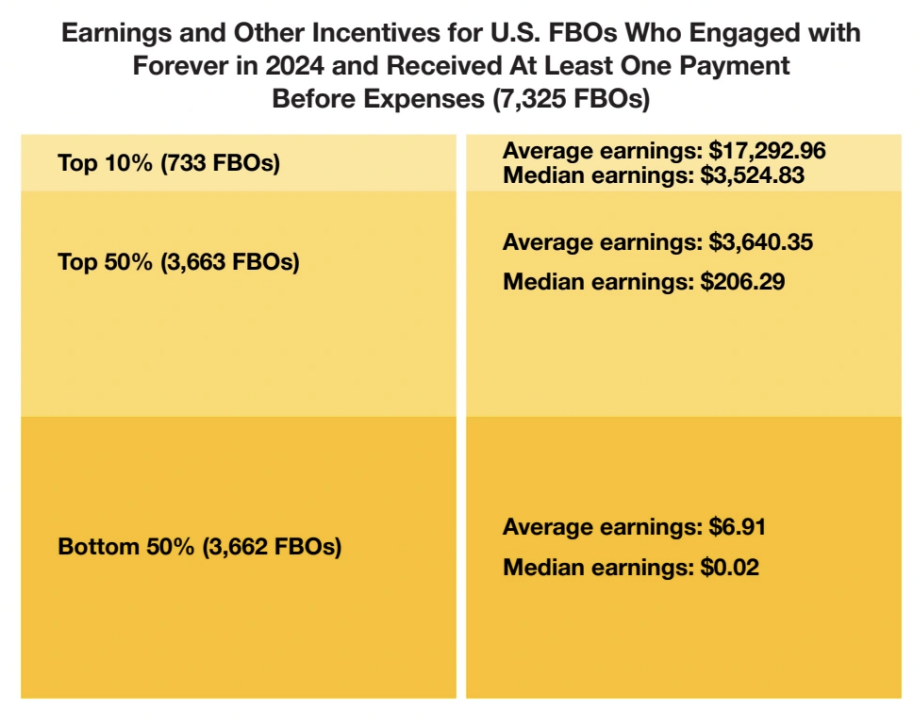
But the reality, as the FTC detailed in its complaint, was starkly different than how Forever Living represented the business opportunity. Internal data showed that the vast majority of participants earned little to nothing. Nearly 77% of U.S. FBOs who were active in 2024 received no income from the company at all, and another 15.4% earned less than $206 – before expenses. Fewer than 8% earned $206 or more annually, again before accounting for the costs required to participate in the business opportunity. (Such expenses included shipping costs, which the FTC said were often missing from hypothetical “profit” calculations in charts and other promotional materials.)
And for new recruits, the outlook was even bleaker. Most participants were required to spend more than $300 upfront to join, yet more than 90% failed to recoup that initial investment in their first year. And despite the central role of recruitment in MLM compensation structures, only a tiny fraction – roughly 7% of FBOs – earned any income tied to their downline, with consistent monthly earnings at meaningful levels limited to a negligible percentage of participants.

The complaint also underscores how Forever Living structured its business in ways that encouraged ongoing spending, even as it targeted consumers in precarious financial situations with Maughan even calling the company “a vehicle for people to rise out of poverty.” Participants were incentivized to purchase large volumes of products each month to remain “active” and eligible for bonuses, with minimum monthly purchase thresholds reaching hundreds of dollars. Yet the company did not track whether participants could actually resell these products at a profit, nor did it have evidence that retail sales actually generated meaningful income for any participants.
The FTC’s complaint further takes aim at Forever Living’s income disclosure statements – often cited by MLMs as a safeguard against deception – alleging that every iteration of the document produced by Forever Living since at least 2022 was itself misleading.
Rather than providing a clear and accurate picture to recruits of what participants typically earn, successive disclosures presented earnings data in ways that obscured the reality: that most participants make little or nothing. For example, the company highlighted limited subsets of “active” participants (see chart below), while failing to adequately account for the large number of individuals who earned no income at all, thereby skewing the overall impression of potential earnings. It also reported income figures without factoring in any expenses participants incurred, such as startup costs, ongoing product purchases or shipping charges. As a result, even when Forever Living pointed consumers to its disclosure statement, the document did not correct the misleading compensation message but instead reinforced it, giving the appearance of transparency while continuing to falsely suggest that meaningful income was attainable for the typical participant.
The proposed settlement, filed in Federal District Court in Arizona, imposes strict and far-reaching requirements on Forever Living and its two top corporate leaders. Most notably, defendants are permanently barred from making any earnings claims – express or implied – unless they are truthful, non-misleading, and supported by competent and reliable evidence at the time they are made. This includes not only claims about potential income, but also representations about typical earnings, recruitment success, and even explanations for why participants fail. In addition, the company must maintain substantiation for any income-related claims and make that information available to both the FTC and prospective participants upon request.
Forever Living did not respond to a request for comment.
This action against Forever Living sends a clear signal to the MLM industry: Regulators are continuing to prioritize deceptive income claims, and companies will be held accountable not only for what they say directly, but for the overall impression their marketing creates. This is particularly important in an industry where aspirational messaging is often used to recruit participants seeking alternative sources of income.
Ultimately, the lesson of the Forever Living case is a simple one. When a business opportunity is marketed as a path to financial success, the claims used to promote it must reflect the typical experience – not the exceptional one. For the thousands of Forever Living distributors who invested time and money chasing the company’s representations of riches that never materialized, that principle comes too late. But for the broader marketplace, the FTC’s action is a reminder that truth in advertising is not optional – it is the law.
Find more of our coverage on MLMs.
TINA.org investigation finds 98% of MLMs using misleading income claims.

Prohibited content slips through the cracks.

The MLM has been making deceptive earnings claims for the past decade.