
What You Should Know about USANA
Supplement MLM takes down dozens of deceptive claims following TINA.org investigation.
UPDATE 4/14/26: Forever Living has reached a settlement with the FTC over its use of deceptive income claims to market its business opportunity. The proposed order – filed one day after the FTC brought its complaint against the company – prohibits Forever Living, as well as its CEO and president, from making any earnings claims without supporting evidence. Despite touting the business opportunity as a means to earning extra or even full-time income, the FTC alleged most Forever Living distributors make nothing or lose money. The FTC’s lawsuit references TINA.org’s May 2022 complaint to the agency (discussed in more detail below).
—
Another prominent MLM is leaving multilevel marketing.
Effective May 1, Forever Living – a longtime MLM and the subject of multiple TINA.org investigations – will no longer allow distributors to recruit others into the business opportunity, according to a recent update to the company’s policies and procedures and an announcement on its website. However, per the update, distributors will still be able to generate earnings from “existing downline purchasing” under the current MLM structure until the end of 2026.
Without providing details, Forever Living in the update cites restrictions including “ongoing monitoring and structural requirements” that it says prevent it from continuing to operate as an MLM. The transition to “a model centered on product sales and long-term compliance” will only affect the company’s U.S. operations. Forever Living, which sells a variety of aloe vera products, operates in more than 160 countries.
The move comes as several other well-known MLMs have also exited the industry in recent years, either by choice or by force. Some notable examples include Rodan + Fields, Beachbody (now known as BODi) and AdvoCare, which was banned from the MLM industry after the FTC accused it of operating an illegal pyramid scheme disguised as a legitimate business opportunity.
At the same time, the Direct Selling Association, which consists primarily of MLMs, has seen its membership decline, including a 30 percent drop in membership last year, with AdvoCare and Rodan + Fields among those leaving the DSA in the last 12 months. As of this writing, Forever Living remains a DSA member.
While Forever Living is abandoning the MLM model, the reality is the company’s business opportunity isn’t – and hasn’t been – much of an opportunity to begin with.
Its current income disclosure statement reveals that in 2024, nearly 70 percent of distributors “did not receive any payments” and for the roughly 30 percent that received at least one payment, the median annual earnings were only about $44 before expenses. And it was no better in 2022, when in an average month, the vast majority of distributors – nearly 89 percent – earned nothing.
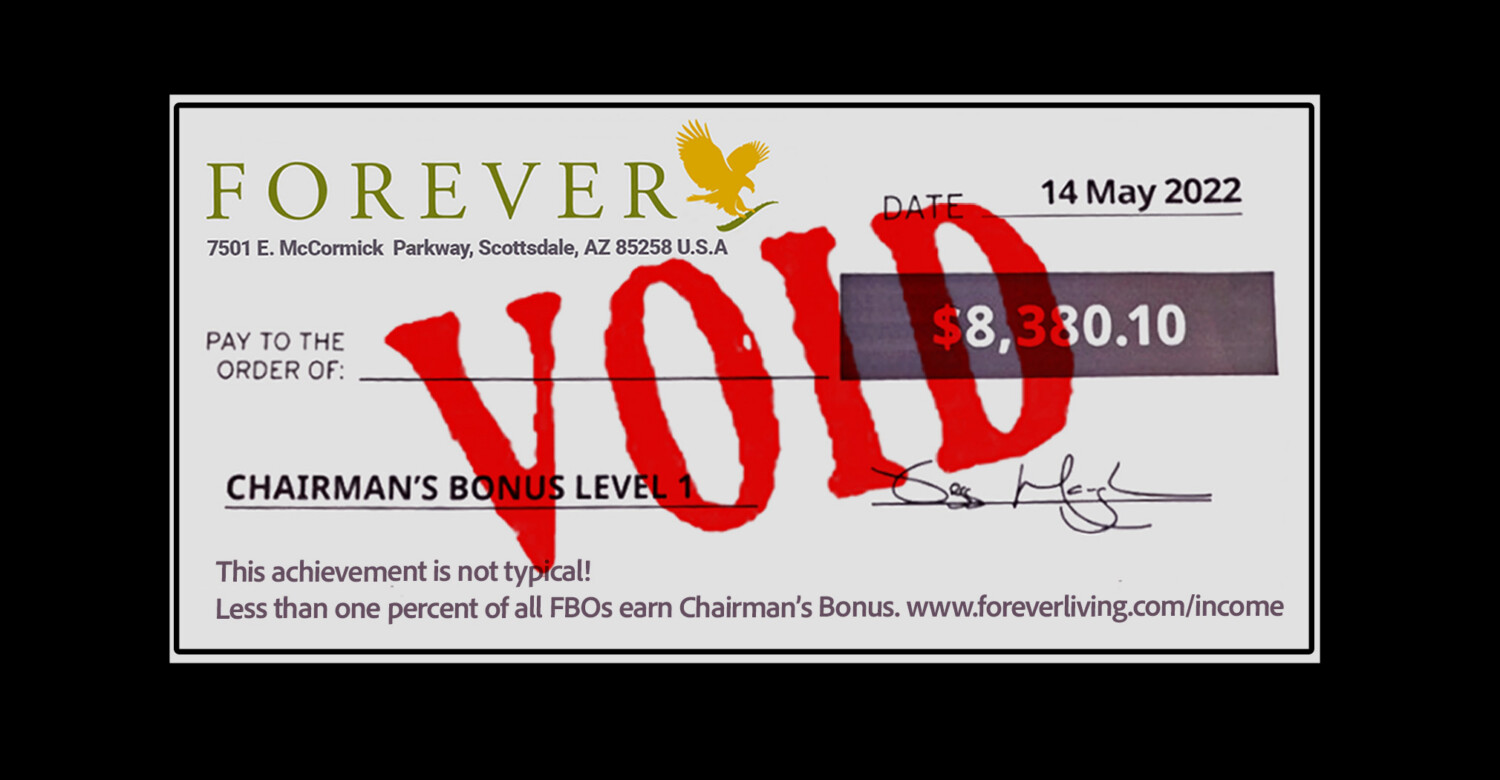
Yet this did not stop Forever Living from marketing the business opportunity as a way to earn a full-time and uncapped income, or from approving and publishing thousands of images of distributors receiving giant bonus checks. As part of a 2022 investigation into Forever Living, TINA.org amassed a sampling of more than 5,500 deceptive income claims – all made directly by the company and its high-level executives.
In May 2022, TINA.org filed a complaint against Forever Living with the FTC – seven months after the agency sent the company (among hundreds of other MLMs) a notice of penalty offenses concerning money-making opportunities. Following our complaint to the FTC, Forever Living removed more than 2,400 deceptive income claims from publication and restricted access to over 3,300 misleading earnings claims.
TINA.org first alerted consumers to Forever Living’s deceptive income claims in 2017 as part of a larger investigation into DSA-member companies (including AdvoCare, among dozens of others) that found 97 percent of all DSA members using atypical earnings representations in their marketing. One of the Forever Living examples collected was a video of the founder in which he tells distributors:
[W]hen I started the company, I didn’t have a product, but I knew I had a marketing plan that was gonna help all of you be more wealthy and wiser.
Last November, Forever Living’s deceptive income claims attracted the attention of the Direct Selling Self-Regulatory Council, which cited 13 social media posts containing misleading earnings representations. But after the company addressed those specific examples, the DSSRC closed its inquiry.
Forever Living did not respond to a request to comment.
This is not the first time an MLM that was the subject of a TINA.org investigation has left the industry. In 2022, following an investigation and complaint to the FTC against Team National over the company’s deceptive marketing of its business opportunity, it withdrew from the MLM industry and direct selling entirely.
Other MLMs targeted by TINA.org have succumbed to worse fates.
Last May, the FTC and state of Nevada filed a lawsuit against IM Mastery Academy for bilking consumers out of more than $1.2 billion in “a wide-ranging investment training and business venture scam” dating back to 2018. That was when the MLM was known as iMarketsLive and also when TINA.org began warning consumers about a myriad of issues with the company, including its use of deceptive income claims.
After attempting to rebrand itself under a different name, the company shut down. And as of September, the FTC had already reached settlements with a number of defendants, who collectively agreed to pay $13 million.
Find more of our coverage on MLMs.
Supplement MLM takes down dozens of deceptive claims following TINA.org investigation.


Deceptive health and income claims, including some tied to COVID-19, persist in wake of warning from the feds.