
2025 Deceptive Ad Trends
A closer look at what we’ll be monitoring in the new year.
Prediction market faces legal challenges on multiple fronts.

Kalshi pitches itself as a prediction market built on the wisdom of the crowd – the idea that groups of individuals operating independently can make more accurate collective judgments about future events than any single expert.
The company’s “event contracts” allow users to bet on the outcome of real-world events across a range of topics from economics and politics to sports and culture. Kalshi claims the contracts are priced to reflect “the market’s collective assessment of the probability that an event will occur,” enabling it to “predict the future.”
It’s a bold claim but perhaps not as bold as Kalshi’s assertion that it is “legal in all 50 states” – a claim that dozens of states and numerous class-action lawsuits have challenged – or its representations that users can make large sums of money quickly and easily on the platform.
Founded in 2018 by two MIT graduates, Kalshi claims to be the world’s largest prediction market, with a recent valuation of $22 billion.
Here’s what you should know about Kalshi.
On Kalshi, users purchase “event contracts,” staking between one cent and 99 cents (plus Kalshi’s fee, which is generally an additional 1%-1.5%) on whether a future event will or will not happen. Kalshi frames each event as a yes/no question. For example, one recent contract asked, Will “The Devil Wears Prada 2” score above a 77 on Rotten Tomatoes?
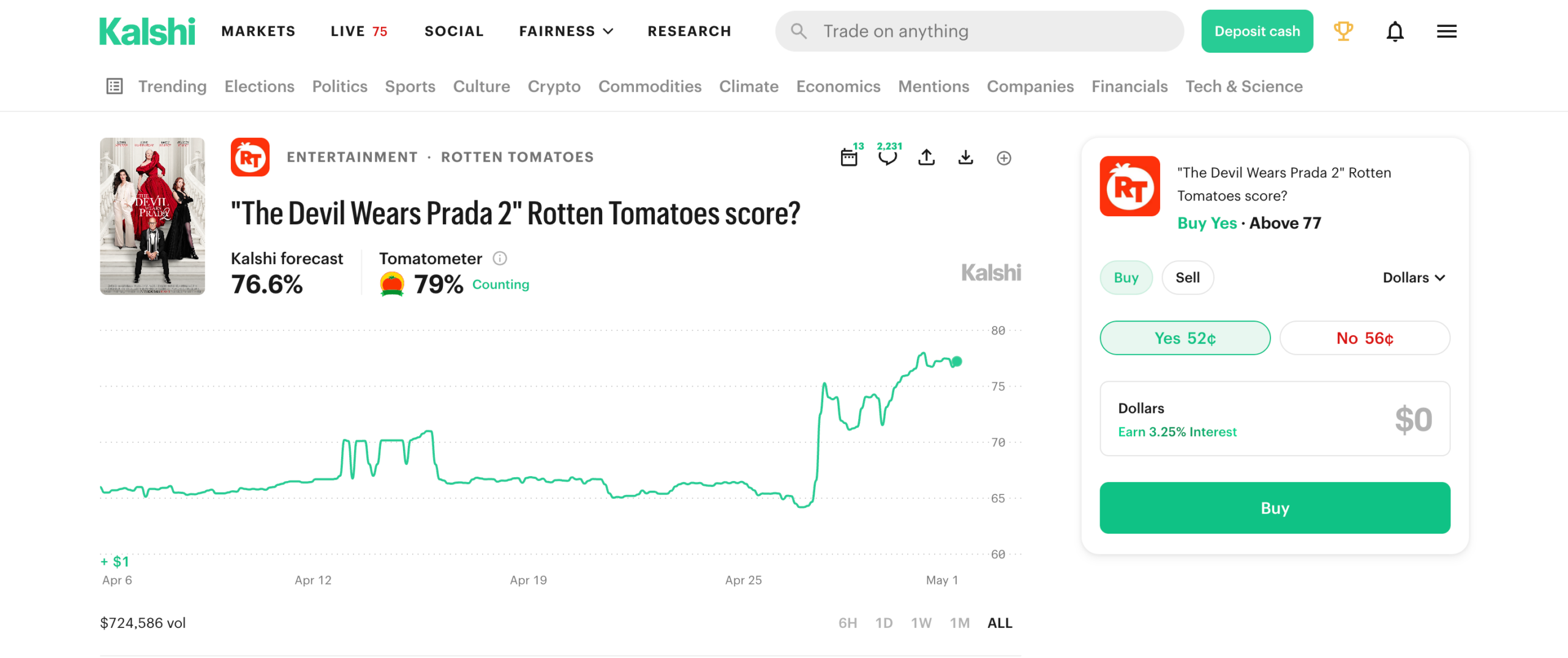
For each event, Kalshi says it matches users who purchase “yes” contracts with those who buy “no” contracts, and vice versa, so that when the event settles, the user who correctly predicted the outcome receives $1 – their stake and that of the user who purchased the opposite contract. Users can purchase multiple contracts for a single event, up to $25,000.
According to Kalshi, its contracts are priced to correspond roughly to the probability of the event actually happening. So if a user purchases a “yes” contract for 30 cents, there is a 30% chance of the event actually occurring. As such, buying a “yes” contract for an event that has a lower likelihood of happening results in a higher payout.
A contract can increase or decrease in value – for example, a “yes” contract purchased for 50 cents can later increase in value to 70 cents or decrease in value to 30 cents – and users have the option to sell their contract at the current market price before the outcome of the event is known.
Kalshi classifies its contracts as commodity derivatives, which are regulated exclusively at the federal level by the Commodity Futures Trading Commission (CFTC). “As such, we are 100% legal everywhere in the U.S.,” the company says on its website. Its social media ads echo the claim, stating Kalshi is “legal in all 50 states.”

But an increasing number of states disagree. They argue that Kalshi’s event contracts – particularly its sporting event contracts, which account for the vast majority of trading volume on the platform – are “indistinguishable from traditional sports betting” and should be regulated at the state level.
In late April, 40 states and the District of Columbia sent the CFTC a letter arguing that the federal agency “lacks exclusive jurisdiction” over sports-related contracts (offered as event contracts on prediction markets such as Kalshi) and that “the regulation of sports gambling” belongs with the states.
The debate has escalated into a multifront legal fight.
Since March 2025, more than a dozen states have sent Kalshi a cease-and-desist letter and/or filed a lawsuit against the company alleging illegal, unlicensed sports gambling. Kalshi has sued over 10 states accusing them of intruding on the federal government’s “exclusive authority” to regulate prediction markets under the Commodity Exchange Act (CEA). And the CFTC has taken several states to court challenging their ability to regulate the platform.
Both Kalshi and the states have already been able to claim victories.
In April, a federal appeals court affirmed a lower court ruling barring New Jersey from enforcing its state gambling laws against Kalshi, holding that the company’s sporting event contracts are “swaps” under the CEA and fall under the CFTC’s exclusive jurisdiction. Nevada and Massachusetts, meanwhile, have each obtained temporary bans against Kalshi.
Where is this all headed? Some gaming experts believe the dispute over whether prediction markets are a federal or state matter may ultimately reach the Supreme Court.
Several class-action lawsuits have also been filed against Kalshi alleging it markets itself as a legal prediction market when it is actually an illegal gambling operation.
Meanwhile, Kalshi continues to run social media ads attempting to differentiate itself from “predatory sportsbooks.”

However, in its efforts to attract users, Kalshi makes some questionable claims of its own.
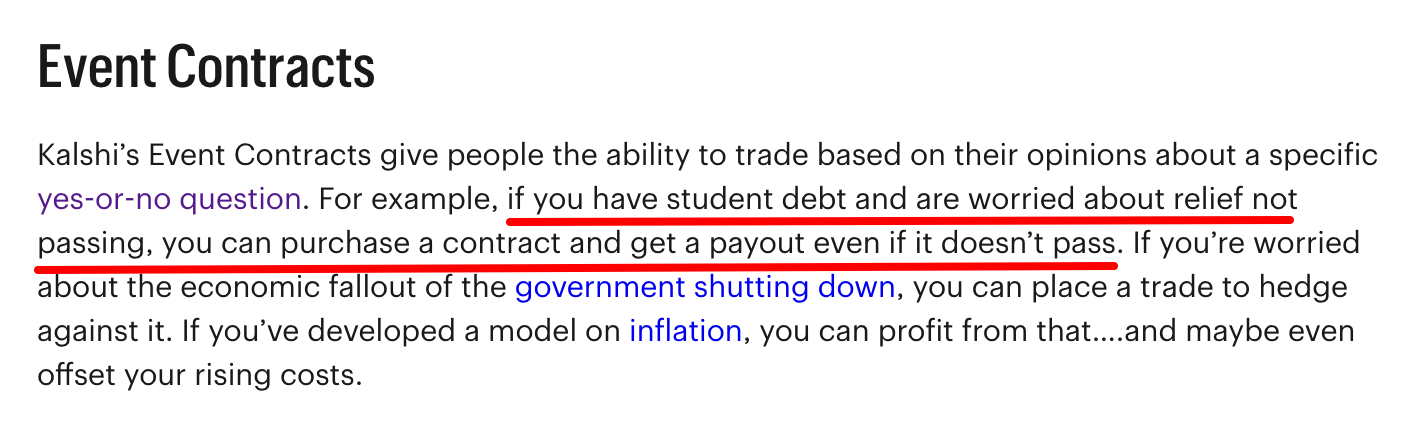
Kalshi’s ads claim users can easily make hundreds to thousands of dollars on the platform – enough to pay rent or student loans.
But according to reports, users typically lose money on the platform. And according to the FTC, ads featuring consumer success stories must properly disclose typical – or “generally expected” – results. But such disclosures are missing from Kalshi’s ads.
In response to a request for comment by TINA.org, Kalshi could not provide data on typical user outcomes that would support its earnings claims.
Some ads also omit any information about the risks, odds or cost of using the platform. (In other ads, Kalshi does disclose the odds and cost above advertised potential payouts, some as large as six figures.)
Among the class-action lawsuits filed against Kalshi is one alleging that the company aggressively targets consumers aged 18 to 20 in states that restrict sports betting to those 21 and older, including through a “College Ambassadors” program designed to promote gambling on campuses.
Kalshi has also featured MrBeast – the biggest YouTuber in the world, whose audience is primarily made up of teens younger than 18 – in its marketing materials and event contracts.
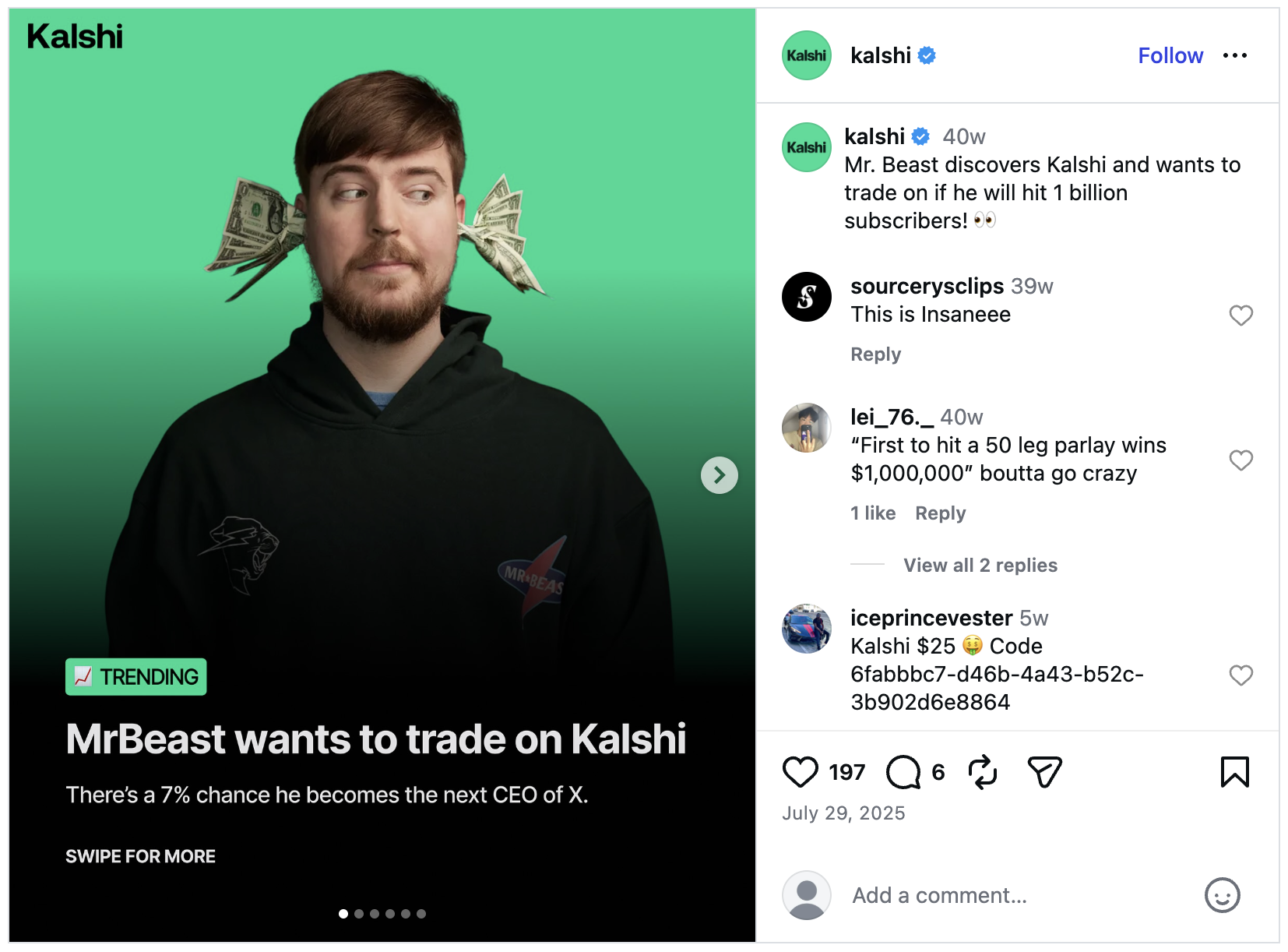
Kalshi told TINA.org that the lawsuit misrepresented the college program, which it said it no longer offers. The company said that it requires users to be at least 18 years old and that MrBeast appeals to a diverse population of consumers.
Class-action lawsuits against Kalshi also allege that the company:
In response to a request for comment, Kalshi disputed the allegations in the lawsuits, which are pending.
Another pending class-action lawsuit accuses Kalshi of violating Washington state law by sending promotional text messages to consumers who had not consented to receiving such messages. Kalshi did not respond to a question regarding the lawsuit.
Of note, the platform also uses smartphone push notifications – which have been shown to be highly effective at acquiring and maintaining consumer engagement – to advertise to consumers. However, with respect to Kalshi, some consumers have called this practice “predatory,” while others have complained about being bombarded by push notifications on a daily basis.
If you’re going to get involved in Kalshi, know all the risks, understand how the fees work and don’t bet more than you can afford to lose. And as the CFTC says in its do’s and don’ts on prediction markets, be cautious of “promises of big payoffs.”
Find more of our coverage on betting.
A closer look at what we’ll be monitoring in the new year.

And the regulatory efforts that seek to curb them.

A TINA.org analysis of Roblox consumer complaints filed with the FTC.