
TINA.org Supports Citizen Petition Calling for AI Pricing Transparency
Why disclosures are key to protecting informed consumer choice and competition.
JetBlue’s policy on “Flight Disruptions,” as advertised on its website, is notably clear: In certain circumstances, customers may cancel and receive a full refund. One such circumstance is a domestic flight arrival delay of more than three hours. The policy lists no caveats, exceptions or qualifying language. (This standard is also required by the U.S. Department of Transportation.)
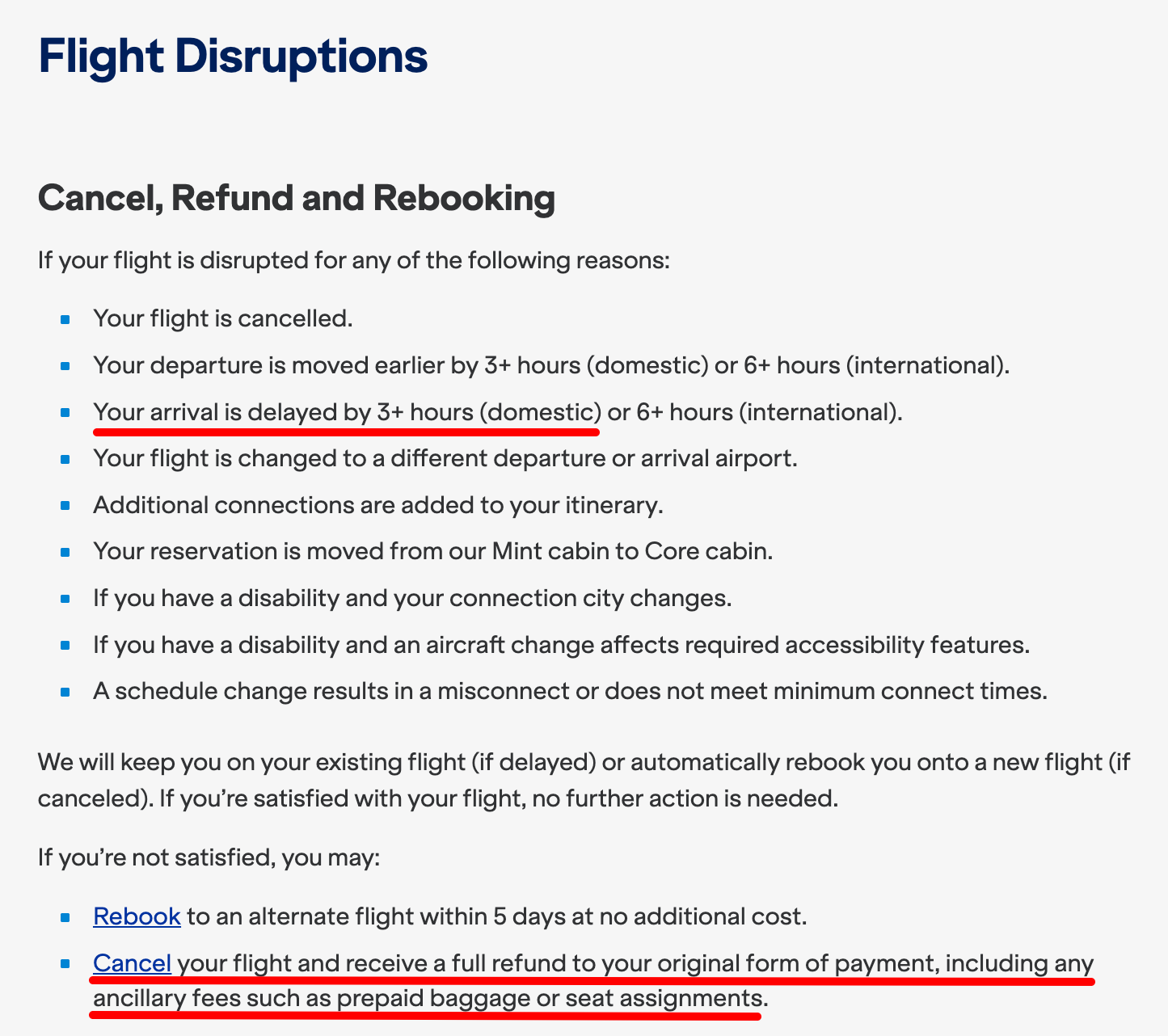
However, when a flight fell squarely within that policy, the airline’s commitment to its customers and its application of its own rules became far less clear.
A JetBlue flight I booked in October for travel the following February was initially scheduled to depart at 2:55 p.m. and arrive later the same day in the same time zone at 5:49 p.m. That particular schedule was a big part of why I booked this flight over other comparable airlines’ flights.
Ten days later, however, JetBlue sent me an email titled “JetBlue flight schedule change – No action needed” informing me that the times for the flight I booked had changed by about an hour and a half (now departing at 4:30 p.m. and arriving at 7:34 p.m.). Upon receiving this notice just days after booking – and approximately four months before the scheduled trip – I called the airline to ask if, under these circumstances, and given how far out the trip was, they could refund me the ticket so I could book on another airline at a better, more suitable time.
The customer service representative told me that because the change in time was a less than a three-hour difference, I was not eligible for a refund. She told me I could keep the flight, cancel it for a JetBlue credit, or wait to see if the flight would be further delayed to fall within the refund policy. I opted for #3.
Then, two months later, I received another email from JetBlue with the same heading. The airline was changing my flight times again, now to depart at 5:50 p.m. and arrive at 8:53 p.m., 3 hours and 4 minutes later than when I was originally scheduled to arrive at my destination.
So I called JetBlue for a second time, this time invoking my right for a refund now that the change to my arrival time was more than three hours.
What followed was nearly an hour of calls, holds and transfers, including denials of a refund and an escalation to a higher-level representative. The JetBlue agents provided multiple (and conflicting) reasons for trying to deny me a refund – none of which appear in JetBlue’s published policy.
Having been informed at the outset that the call would be recorded, I asked the escalation representative for a copy of the recording of our phone call, explaining that I needed it for possible litigation purposes. I wasn’t sure what my next step would be but I wanted our conversation preserved.
It was not long after this request that the conversation changed. No more policy parsing. No more fabricated distinctions. No more excuses.
The customer service rep told me she would be refunding me my money for the changed flight.
The refund itself resolved my individual dispute, but broader concerns remain. How consistently is JetBlue applying its published policy? Are customers routinely required to escalate, persist and threaten legal action to obtain refunds to which they are plainly entitled? Are its agents appropriately trained on the application of its policies? Does its approach align with the airline’s public commitment to deliver “the best possible travel experience – even when things don’t go as planned”? And, more fundamentally, are clearly stated rights meaningful if enforcing them depends on endurance rather than policy?
Unfortunately, my experience with JetBlue’s customer service doesn’t seem to be an isolated incident. And last year, the U.S. Department of Transportation imposed a $2 million penalty against the airline for operating multiple chronically delayed flights.
TINA.org’s team reached out to JetBlue for comment. In response, the company requested additional details related to the episode described above. But after providing the information, we didn’t receive a response.
The takeaway? Read the policies, know your rights and don’t let companies try to rewrite their commitments on the fly.

Why disclosures are key to protecting informed consumer choice and competition.
Why agency independence is in the best interests of consumers.

And why the problem is even worse when those human viewers are kids.