
A List of Freebies
Before paying a company for something, know all your options.
Complaint to FTC cites violations of agency’s Impersonation Rule.
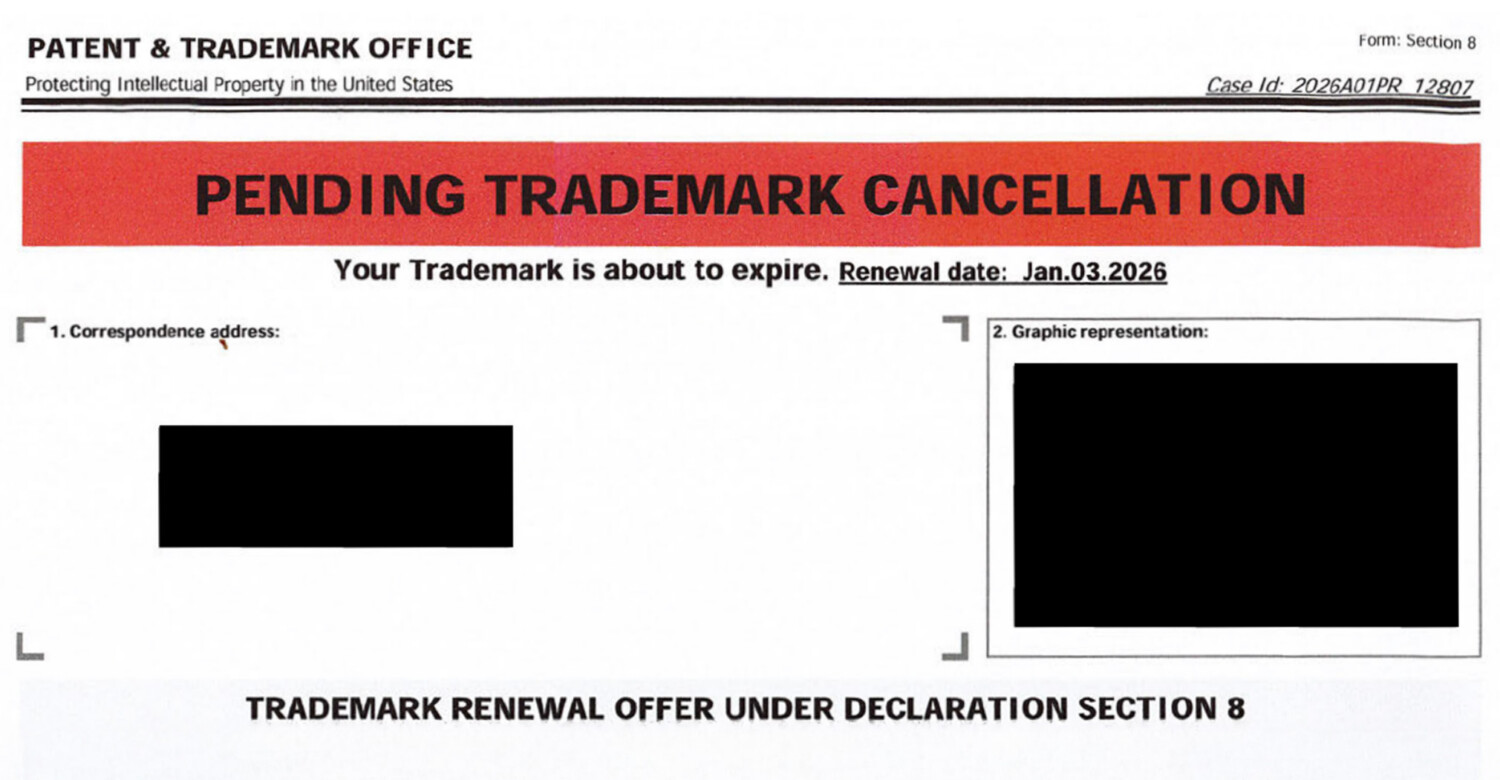
Savvy business owners know the importance of a trademark. Registering and maintaining a trademark with the United States Patent and Trademark Office not only protects brand identity – so that companies can separate themselves from their competitors – it also helps guard against counterfeiting and fraud.
Unfortunately, scammers know this too and use information in trademark applications and registrations – which is publicly available – to target business owners and other trademark holders and scare them into handing over their hard-earned dollars.
On Monday, TINA.org took action against one of these government imposters, filling a complaint with the FTC against Patent & Trademark Office, a Washington state-based company that has been masquerading as the U.S. Patent and Trademark Office for years.
In mailings to consumers, the company warns of a “pending trademark cancellation” if recipients don’t pay more than $1,000 to renew their registration. The mailings are designed to look like legitimate notices from the U.S. government in a number of ways:
The sole disclosure that the sender is a “private company” – and not in fact part of the U.S. government – appears in a single sentence buried in a dense paragraph of text in the middle of the document.
Our investigation found that Patent & Trademark Office is violating the FTC’s Impersonation of Government and Businesses Rule, as well as the FTC Act.
The FTC’s Impersonation Rule went into effect in 2024 following a precipitous rise in reported losses to business and government imposter scams, from $310 million in 2020 to $1.1 billion in 2023. (Actual losses are likely significantly higher as the vast majority of frauds aren’t reported to the government.) TINA.org filed a comment in support of the proposed rule in 2022.
Among the consumer groups that the rule seeks to protect are small business owners, who appear to be the primary targets of this trademark scam.
Even in a strong economy, many small businesses fail. Meanwhile, Patent & Trademark Office is seeking to extract fees well in excess of what the government actually charges to maintain a registered trademark, while posing as the government.
In response to a request for comment on our complaint to the FTC, Patent & Trademark Office said its “trademark renewal offer clearly states that we do not associate ourselves with the USPTO.”
The bottom line
The FTC has the opportunity to send a clear message that impersonating government agencies and exploiting small business owners and others for financial gain will not be tolerated. Indeed, combatting and deterring this type of deception are why the agency established an Impersonation Rule in the first place.
In the meantime, if you are a trademark owner, you can use the USPTO’s online Trademark Status & Document Retrieval tool to check the status of applications and registrations.
Find more of our coverage on imposter scams.
Before paying a company for something, know all your options.
MADISON, CONN. Feb. 11, 2026 – A company calling itself “Patent & Trademark Office” is violating the FTC’s Impersonation Rule as well as the FTC Act by falsely posing as…

TINA.org files comment in support of proposed rule.