
MLMs Are Consistently Leaving Participants Behind
New book explores why MLMs are often associated with harmful outcomes – and what can be done about it.
New research points to “no.”
| Stacie Bosley

To anyone paying attention to the multilevel marketing (MLM) industry, it is not news that MLM companies and their representatives often use atypical earnings and lifestyle representations in promotion and recruitment. As TINA.org found in its investigations (in 2017 and again in 2024), nearly all MLMs studied “misrepresented the amount of money typical participants were likely to earn.”
Regulators have taken notice. In the last few years, the FTC has issued Notices of Penalty Offenses to hundreds of MLMs regarding misleading income claims, published updated staff guidance on deceptive earnings and product claims, communicated concerns about income representations directly to the industry, conducted an analysis of MLM earnings and income disclosure statements and proposed a new Earnings Claims Rule for the industry. For its part, the industry created a self-regulatory body – the Direct Selling Self-Regulatory Council (DSSRC) – “to address earnings claims (including lifestyle representations) … to ensure a high level of accuracy and adequate substantiation of those claims, thereby maintaining and enhancing the confidence of consumers in the direct selling business model.”
On the regulatory side, the FTC’s proposed Earnings Claims Rule has not yet taken effect. On the self-regulatory side, the DSSRC has issued multiple versions of its Guidance on Earnings Claims for the Direct Selling Industry (most recently in 2022). The DSSRC guidance articulates expectations for the use of earnings claims and corresponding disclaimers – expectations the DSSRC says it will apply when evaluating MLM marketing materials in self-regulatory inquiries.
In contrast to the “results are not guaranteed” style of disclaimer commonly employed in the past, the DSSRC guidance states that an atypical representation should be accompanied by a clear statement that conveys the income of the “typical salesforce member.” Additionally, the statement shouldn’t be buried in fine print or placed away from the claim but must be “clear, conspicuous, and in close proximity to the triggering representation” (emphasis in original).
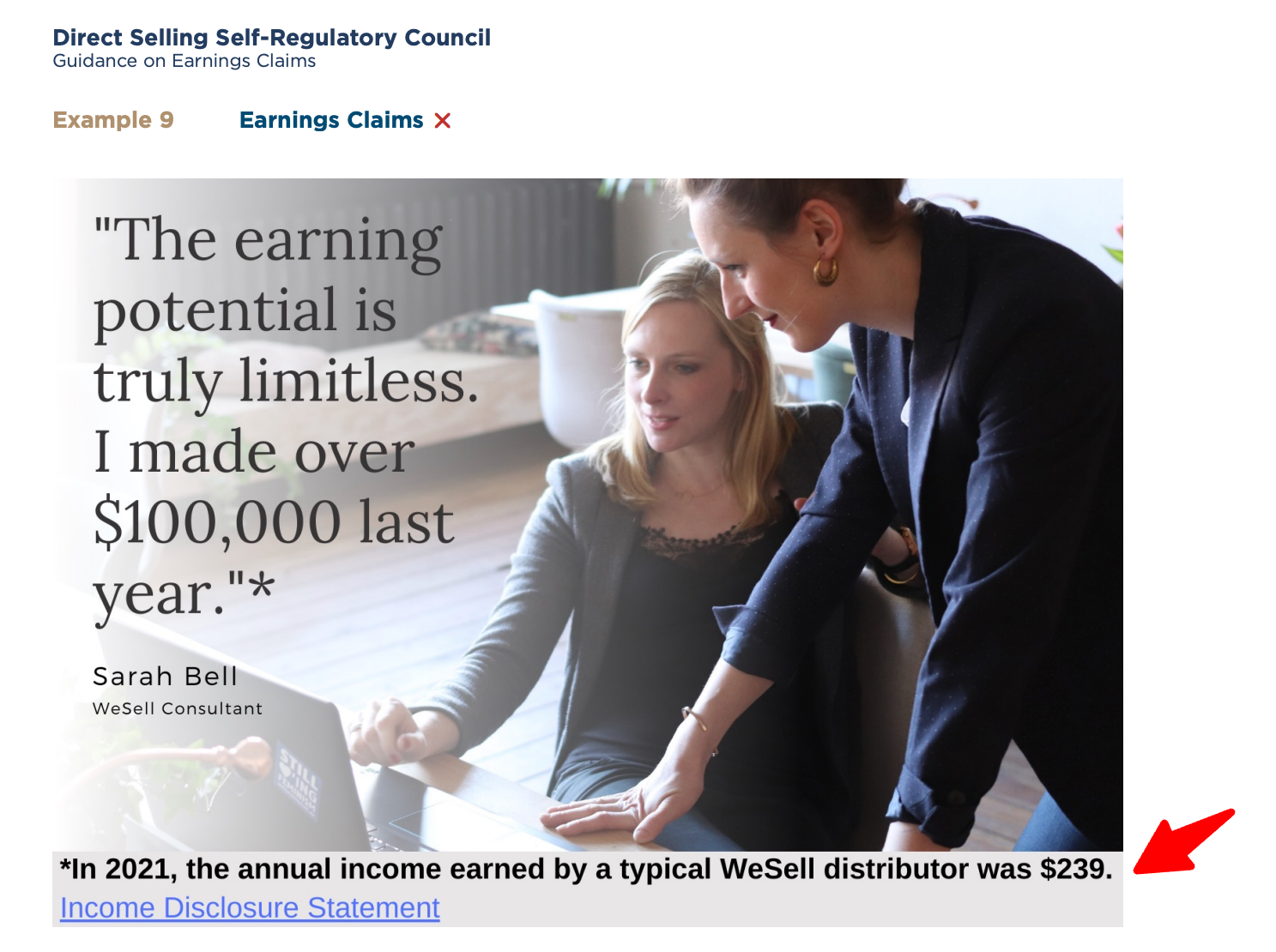
The DSSRC guidance provides examples to illustrate what the self-regulatory body expects MLMs and their representatives to do – or not do – in practice. One of the examples, shown below, depicts an earnings claim – of limitless income and earnings over $100,000 – that it says is out of bounds, as it “would be considered extraordinary and incapable of being qualified with an appropriate disclosure when being communicated to a general audience.”
In another example, shown below, the DSSRC illustrates what it views as a more acceptable atypical claim, coupled with an appropriate disclaimer statement.
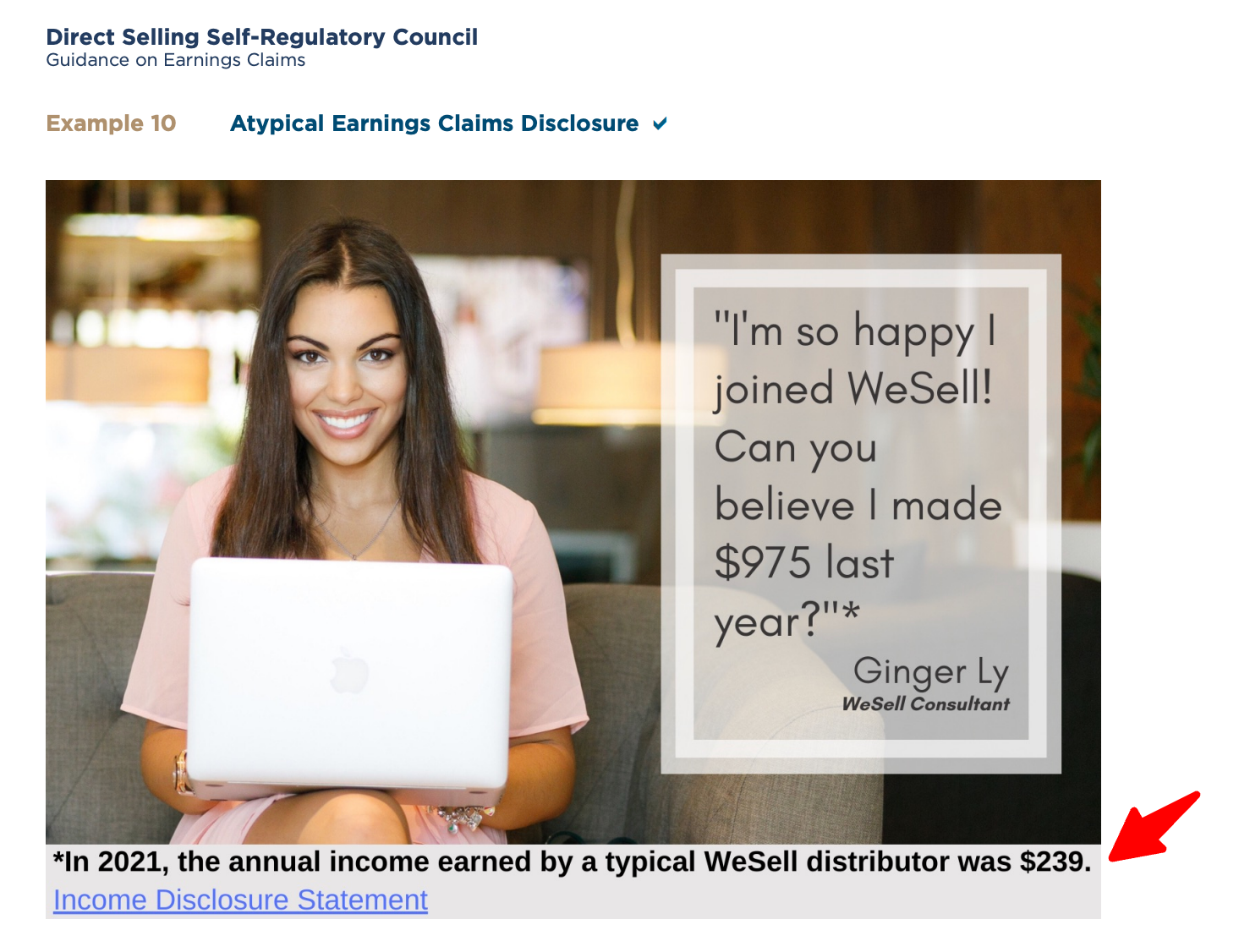
The DSSRC guidance doesn’t just say, “add a disclaimer.” Using a number of examples, the self-regulatory body repeatedly shows MLMs what it expects in a disclaimer statement: a short statement of typical annual income, placed below the claim in clear, bold type, set against a contrasting background color.
It is important to note that some aspects of the disclaimer guidance, in my opinion, are less clear than others. For example, when crafting disclaimers, MLMs are instructed to consider the “mandatory or de facto mandatory costs of participation.” Unfortunately, the interpretation of those terms may vary widely, and MLMs have an incentive to classify nearly all costs as voluntary. In addition, it is not clear if “typical” should be interpreted as median or average, and experts have previously weighed in on the problems of reporting average numbers in MLM when most participants make little or no income while a small group makes significant profit. (Remember your introductory statistics class when you learned how the average income in a bar is affected when a billionaire walks in the room?) That said, the guidance does provide repeated, consistent examples that show what the DSSRC expects for disclaimer content and appearance.
One might wonder whether MLMs are abiding by the DSSRC guidance. In research recently published in the Journal of Public Policy & Marketing, my co-authors and I explore this question. In short, the answer is no.
We examined over 2,000 items of MLM marketing content with one or more atypical earnings or lifestyle representations, collected as part of TINA.org’s 2024 earnings claims investigation and provided in a public database. Using multiple independent raters, we assessed whether each item in the database included an earnings-related disclaimer. If it did, we then evaluated the disclaimer to see if it aligned with DSSRC guidance on both content and appearance.
Of the 2,161 items of MLM marketing content with atypical earnings and/or lifestyle claims in the database, the vast majority (83.2%) had no disclaimer that related to earnings, rewards or lifestyle. Of the 16.8% that did, none of the disclaimers fully aligned with DSSRC guidance and only a tiny number (13 of 2,161, or less than 1%) even came close. Those 13 included a specific statement about the actual outcomes for MLM participants but the disclaimer lacked prominence or proximity.
In sum, the vast majority of MLM content had no disclaimer at all, in clear contrast to the DSSRC’s call for disclaimers to be paired with atypical representations of earnings or lifestyle benefits. Of those that did include a disclaimer, the disclaimers overwhelmingly used vague “results not typical”-style language, and many lacked prominence or proximity.
If MLM firms are not listening to the DSSRC guidance, this begs two questions. First, what if they did listen? And second, how could they be compelled to listen?
To address the first question, we conducted two studies to evaluate the impact of DSSRC-aligned disclaimers. For example, in one study we asked U.S. adults to react to identical MLM marketing content, where the content included atypical earnings representations but with varied disclaimer conditions (randomly assigned). Some were shown the marketing content with no disclaimer at all while others were shown the same marketing content with either a vague disclaimer (“results not guaranteed”) or a specific disclaimer (statement of typical annual income) that was either non-prominent (small, hard-to-read font) or prominent (larger, bolded font with color contrast). In other words, some situations reflected the most common MLM practice (no disclaimer) or the second-most common practice (vague and non-prominent disclaimers), while others saw disclaimers that aligned with DSSRC guidance on content, appearance or both.
What did we find? Earnings expectations and interest in the MLM were significantly higher when people saw the marketing content without a disclaimer, and vague disclaimers (whether prominent or not) did not alter those expectations or interest. In other words, our research suggests that the actual practices of MLMs leave consumers with elevated expectations and artificially inflated interest in the MLM income opportunity. In contrast, expectations and interest fell significantly when people saw the same content, but with a disclaimer statement that reflected DSSRC guidance.
In my opinion, self-regulation will not fix the earnings claims problem in the MLM industry. Simply put, MLMs are not abiding by the DSSRC’s disclaimer guidance, published in 2022, and I do not expect this will change. In the absence of mandatory, standardized disclaimer and disclosure requirements (for those interested, we explore the latter in this recent paper), consumers are likely to have inflated expectations and will lack the information needed to make informed judgments about MLM participation. While federal rules, such as those proposed by the FTC, could be a game-changer, individual states could also take actions to compel MLMs to change their practices. For instance, legislation is being considered in Delaware that would compel MLMs to disclose information to consumers. Given the low or negative returns for many MLM participants and the widespread use of earnings claims in the industry, we cannot rely on self-regulation to be the cure for what ails the MLM industry.

New book explores why MLMs are often associated with harmful outcomes – and what can be done about it.

MLM making deceptive claims after several warnings.

Despite the availability of the data, MLM earnings statements fail to disclose crucial information to recruits, writes guest blogger William Keep.