
Most Deceptive Ads of 2025
Here were some of the worst ads TINA.org investigated this year.
Brand partnerships worthy of a big "doom!"
For this edition of TINA.org’s Monetizing Minors series, we’re checking out Big Justice, who together with his dad are known online as the “Costco Guys.”
When Eric, as a third-grader, teamed up with his aspiring influencer father, Andrew “A.J.” Befumo, the views on dad’s social media channels immediately started climbing. Describing themselves as the Costco Guys, the duo’s videos, featuring their high-spirited trips through Costco and signature hollers of “boom!” whenever they find something they like, have gone viral. From food and toys to cleaning products and vitamins, they enthusiastically buy — and advertise — it all. Despite the great PR for Costco, the nature of the guys’ relationship with the company remains unclear. Their posts don’t disclose any formal partnership with Costco, though A.J. told Rolling Stone that they are on “very, very good terms” with the company. (Costco did not respond to a request for comment.) However, the Costco Guys don’t always properly disclose their material connections to companies and brands they endorse so it can be hard to know when you’re viewing organic content and when it’s an ad. But one thing is for certain: as the father and son’s popularity has grown, so has brand interest. While some collaborations have been with brands clearly aimed at adult viewers, like a partnership with the tax prep company Intuit, others seem to be leveraging Big Justice’s appeal to kids to promote products that may not be in their best interest. Below, we take a closer look at some Befumo content that might be deserving of a big “doom!”
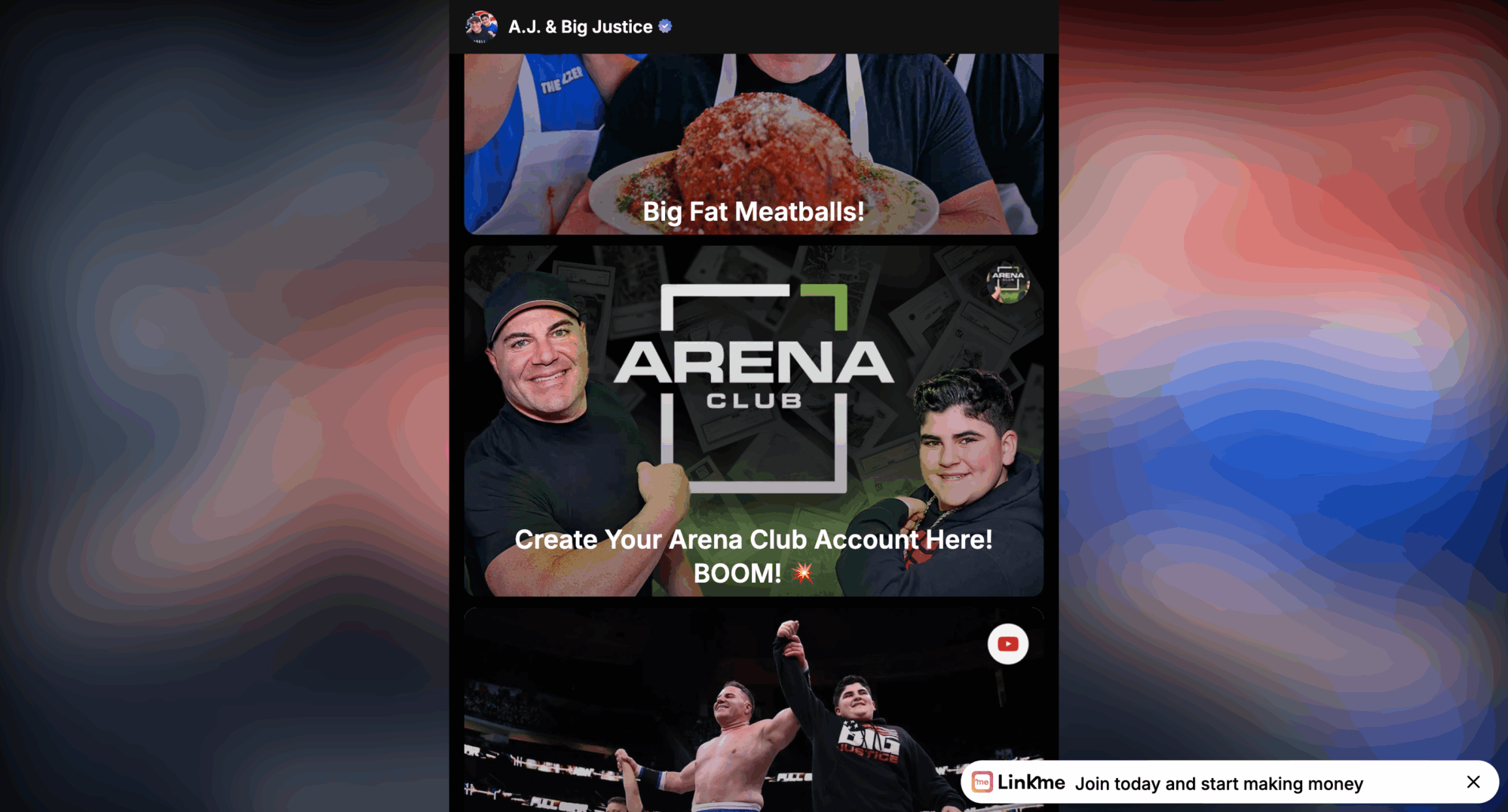
Earlier this year, A.J. and Big Justice, who is a big Pokémon fan, spent $1,200 to buy 10 mystery Pokémon cards so they could play a game of whose random cards were worth more money (presumably on the secondary market where cards are valued depending on their relative rarity and gameplay importance). Given the father and son’s predilection for such antics, it’s not surprising that they’ve caught the eye of sellers of collectible card games, dealers and digital platforms like Arena Club, which allows consumers “to grade, collect, invest, sell and trade” sports and gaming cards online.
In one video from this summer, Big Justice asks, “Do you love ripping sports cards and Pokémon cards as much as we do?” To which dad interjects: “Then you’re gonna love this.” Eric and his dad then explain how they are “teaming up” with Arena Club and that Eric “can’t wait to see you at the Arena Club showroom.” The problem is kids like Eric aren’t supposed to be on the platform as Arena Club indicates in its terms and conditions that the service is not for minors. This is perhaps because of the risky nature of some of the entertainment that can be found on the website, such as the “SLAB PACK experience” in which customers spend up to $250 to purchase random, secret cards for the low chance of winning valuable cards. A.J. and Big Justice’s videos for brands offering mystery card packs often center on the thrill of chance — spending money for the possibility of pulling valuable cards — and they frequently hype the suspense in ways that can mimic gambling dynamics.
Indeed, there is evidence that spending money on packs containing random cards of varying value is linked to problem gambling. Ripping card packs can be psychologically similar to gambling because players can “win” with rare and valuable cards or alternatively “lose” with nonvaluable cards, blurring the line between entertainment and gambling for minors. For kids, the repeated cycle of risk-taking, reward anticipation and intermittent payoff can normalize gambling behaviors long before they’re old enough to understand the financial risks. As brands and platforms continue to profit from this highly engaging format, children are left increasingly vulnerable to developing unhealthy relationships with chance-based spending.
Companies eager to cash in on the recent protein craze are adding it to just about everything including snacks, beverages and even milk. And who better to tap for this momentary cultural obsession than a pro-wrestling dad and his growing son. Brands with protein-fortified offerings appear to be lining up at the Befumos’ door, enlisting the Costco Guys to promote everything from protein snack bars and post-workout drinks to protein-enhanced milk, burrito bowls and dried meats. One such company is the prepared frozen meal brand Eat Clean Bro. In April 2024, Eric posted on Instagram that the company sent him a “customized meal plan” because as A.J explained, “We’re building a better Big Justice and it’s time to work on the nutrition.” Yet the three customized frozen meals Eric said the brand provided for a single day for the then-10-year-old totaled a staggering 148 grams of protein and more than 2,000 calories — amounts that may not be in the best interest of “this guy.”
According to the National Institutes of Health, boys aged 9 to 13 should consume about 34 grams of protein per day, while adult men require around 56 grams a day (with individual needs varying). And it’s important to note that not only can it be unnecessary for kids to consume more protein than is recommended but it can even be harmful. While protein is required for growth and muscle development, excess intake can lead to serious side effects including kidney and liver damage, dehydration, digestive issues and unhealthy weight gain.
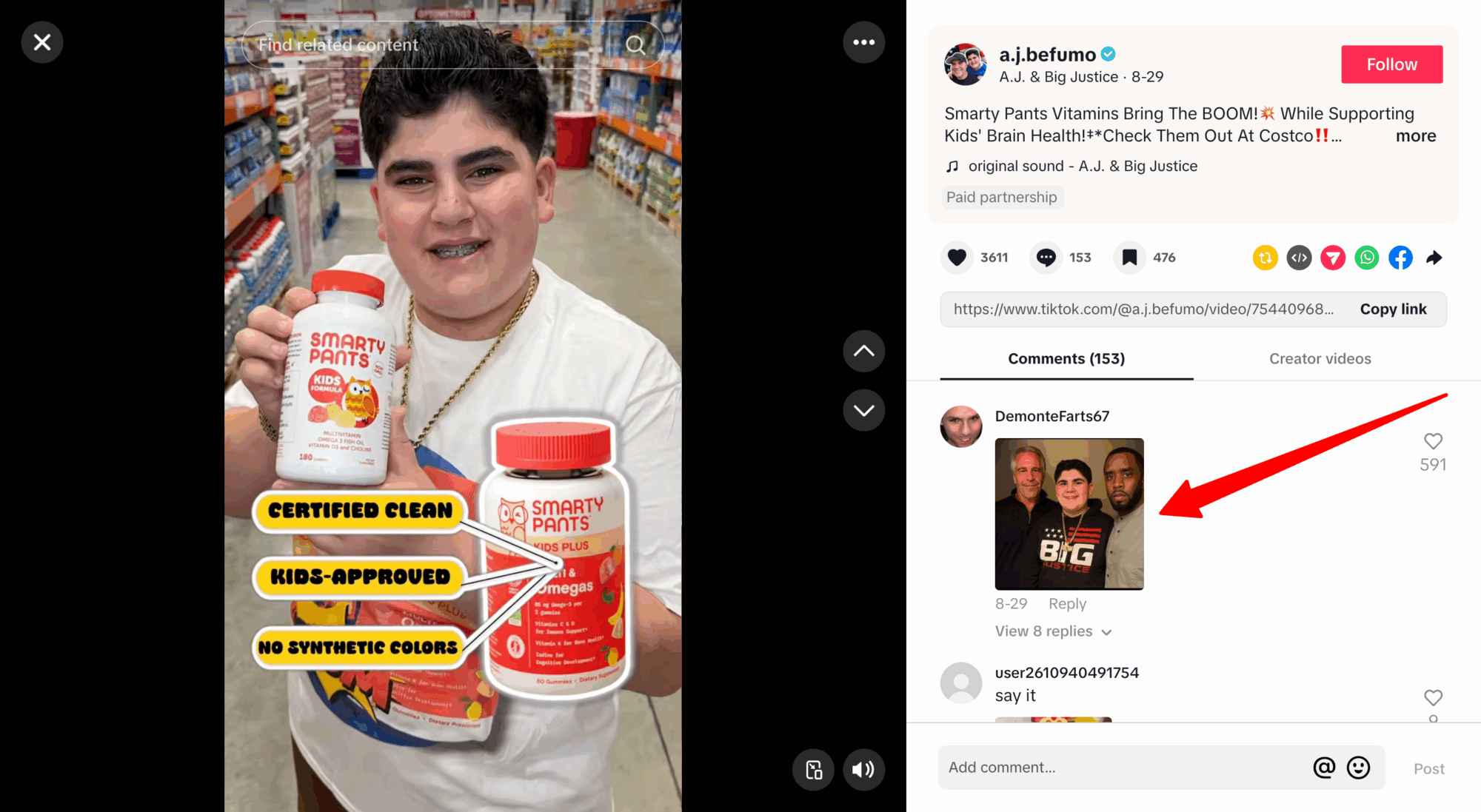
On branded posts featuring Big Justice, there is a troubling pattern of inappropriate comments that appear beneath the marketing messages. Across TikTok, Instagram and YouTube, sponsored content involving Eric (and his sister, Ashley, who is also a minor) routinely attracts sexual, demeaning or otherwise inappropriate comments from users. Yet those responsible for these branded posts appear to do little, if anything, to address these comments. By way of example, on a TikTok ad for Smarty Pants Vitamins, the top comment was once a doctored image of Eric standing beside convicted sex offenders Sean “Diddy” Combs and Jeffrey Epstein. On an Instagram promotion for Eat Clean Bro (posted by the company when Eric was just 10), one of the highest-ranked comments applauded the boy for “cutting his calories.” (After we reached out to Eat Clean Bro, the company removed the post.) On YouTube, under a sponsored short for “Sonic the Hedgehog 3,” one top comment sexualizes Eric’s underage sister while another demeans Christian Joseph, another kidfluencer regularly featured on Eric’s social media channels that goes by “The Rizzler.”
These types of comments are not isolated incidents and they illustrate how branded content involving minors can become a magnet for inappropriate, sexualized or exploitative commentary — and how brands looking to prioritize engagement metrics often look the other way. On social media platforms, follower engagement, including likes, shares and comments, is an important metric determining how widely a post is circulated. The higher the engagement, the more algorithms reward the content with visibility. This means that even negative or disturbing comments can boost the reach of a sponsored post, creating a powerful disincentive to moderate or disable them. Moreover, research suggests that turning off comments can hurt both the influencer and the brand because audiences perceive them as less receptive to consumer feedback, which in turn makes them seem less sincere. As a result, the consequences of silencing comments for influencers are twofold: followers trust them less and brands view them as less effective partners.
TINA.org reached out to all the brands mentioned in this article, in addition to the Befumos. One brand responded.
Eat Clean Bro President and Founder Jamie Giovinazzo said the company provided A.J. with meals, as opposed to a meal plan, and that the meals were intended to be consumed over six days, not a single day. Giovinazzo said the “cutting his calories” comment was “an oversight during a transition period with our social media agency.” As noted above, the post has since been taken down.
While brands are eager to cash in on Eric Befumo’s popularity, his experience mirrors that of many kidfluencers whose fame comes at a steep personal cost. The 12-year-old has had to leave school for a partially isolated, tutor-based education after being repeatedly swarmed by classmates; simple outings like trips to the mall are no longer possible because crowds of fans can quickly become overwhelming; and his social media interactions often devolve into threats or vitriol when Big Justice fails to satisfy the demands of his millions of followers. Yet for the companies profiting from popular kidfluencers like Big Justice, the lure of highly effective marketing seems to outweigh any real concern for the safety, health or well-being of the children they monetize. It’s time for policymakers to consider steps that establish clear protections to safeguard these young marketers and the minors they influence.
Find more of our coverage on products marketed to kids.
Here were some of the worst ads TINA.org investigated this year.
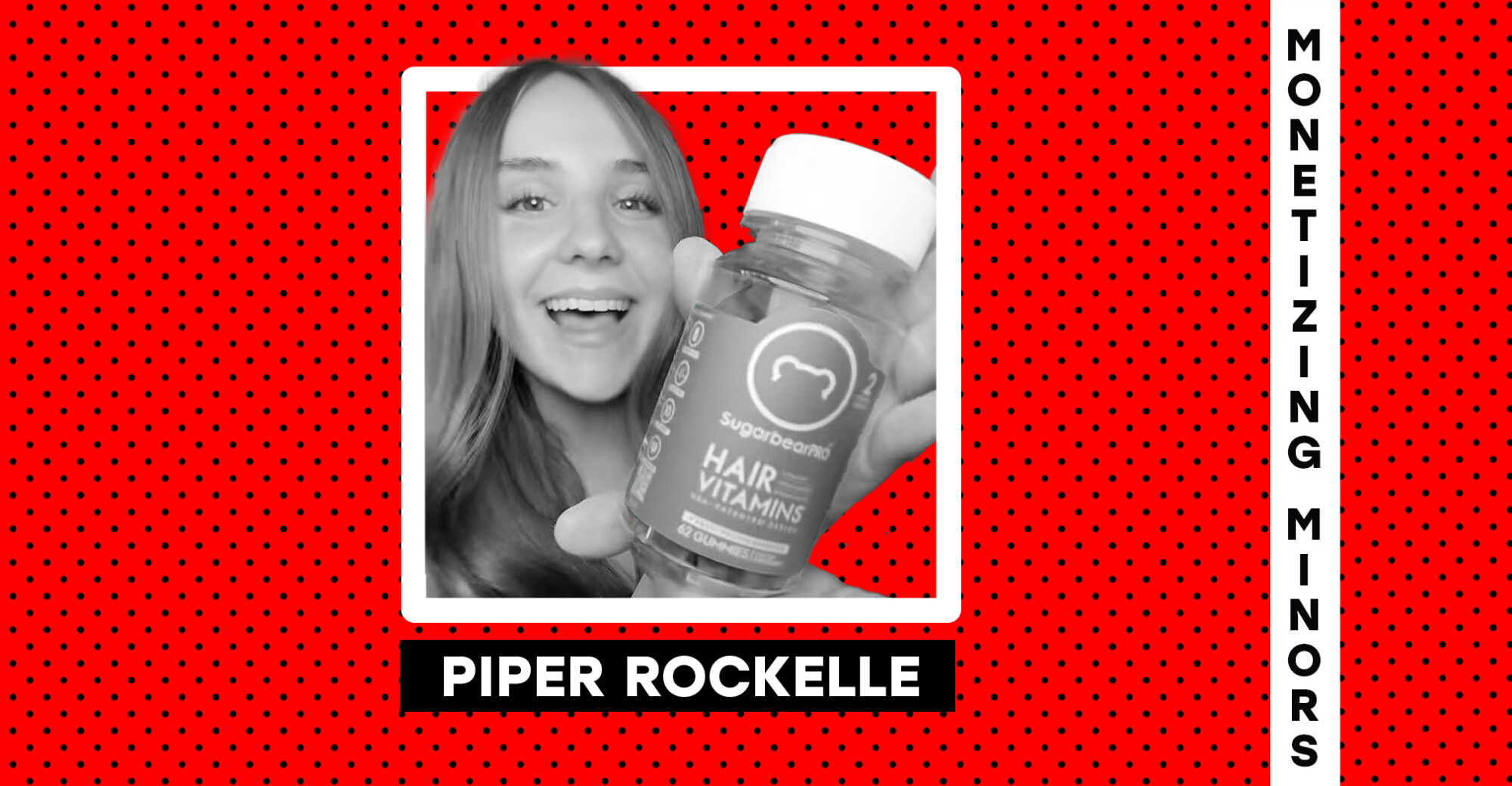
A calorie-counting app is just one of the adult products promoted on this minor’s social media channels.

What’s this kidfluencer doing promoting a “youth cream”?